“I’m still doing everything.”
Work completed. Responsibilities met. Everyday life continues.
Kathleen Morales / A research story
Keeping going? Recovering? Adapting?
The answer changes what we see—and what we measure.
01 / From a word to a framework
Resilience is used to describe a trait, a process, recovery, resistance, or an outcome. Those meanings are not interchangeable. Seeing someone continue to work, care for others, or meet expectations does not tell us what maintaining that functioning requires.
In this framework, resilience is adaptive capacity under changing demands: the capacity to maintain, recover, improve, or transform functioning across time and context.
A proposed conceptual framing, not a validated resilience score.Work completed. Responsibilities met. Everyday life continues.
Which capacities support that functioning? What is being depleted? Is there room for recovery?
02 / A life in context
From conception onward, development unfolds within biological and environmental conditions. The kinds of demand change, and so do the capacities and supports available to meet them. Demands are part of living; their intensity, duration, and distribution are not the same for everyone.
Prenatal conditions
Developing systems
Care and connection
Learning and growth
Identity and belonging
Changing demands
Work and caregiving
Opportunity and constraint
Changing roles
Recovery and support
Illustrative life-course contexts, not a prediction of any person’s trajectory.
03 / Simultaneous, not sequential
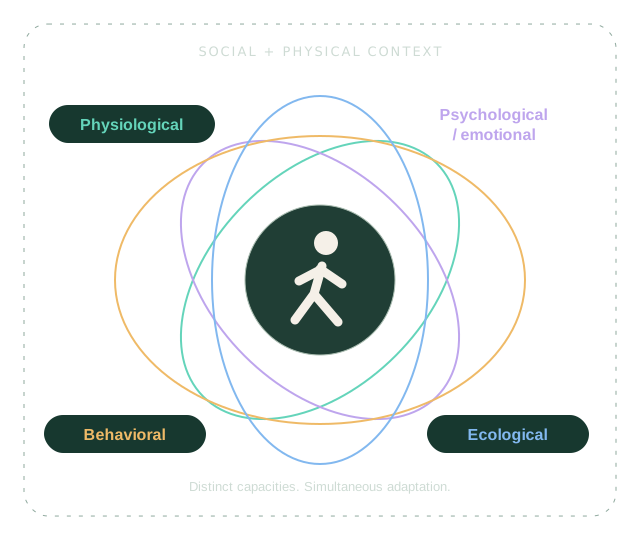
The body regulates, the mind interprets, behavior organizes a response, and relationships connect us with the world. These processes overlap. A strength in one domain does not mean that every other domain is equally supported.
Biological regulation and recovery capacities that support responses to changing demands.
Perceived control, self-efficacy, flexibility, and emotional regulation.
Patterns of activity, sleep, coping, pacing, and recovery.
Belonging, relationships, participation, and navigation of the surrounding context.
Context surrounds all four domains. Structural conditions are not reduced to personal skills, and domain descriptions are not finalized measurement assignments.
04 / Energy ecology
The broader energy-ecology idea asks how surroundings provide support, impose demands, direct attention, and create—or restrict—opportunities for restoration. Here, “energy” is an organizing analogy for capacity and effort, not a common physical unit or a literal equation for resilience.
Conditions, relationships, resources, obligations, and opportunity.
Attention, regulation, action, and changing capacity across domains.
Effort may accumulate; recovery and support may replenish capacity.
The practical aim is to reduce unnecessary expenditure and preserve the capacity to respond. A sustainable state is not necessarily the lowest possible activity level: learning, movement, and change may require effort now to build capacity later.
An intentional-adaptation cycle. Agency matters, but choices remain shaped by resources, safety, time, and structural constraints.
05 / The visual walkthrough
A short presentation adapted from the framework materials. Move through the story at your own pace.
06 / From concept to investigation
Kathleen’s developing thesis brings a multidimensional adaptive-capacity framework to planned investigation in NIH’s All of Us Research Program. It separates stress exposure, capacity indicators, and physiological burden so that their relationships can be examined rather than assumed.
Clarify what each domain means and what belongs outside it.
Connect constructs to available measures and assess their limitations.
Examine associations with physiological burden, subject to data availability and cohort feasibility.
These are conceptual illustrations, not study results. Allostatic load is considered an indicator of multisystem physiological burden, not a direct meter of energy expenditure or an interchangeable measure of resilience. The framework and its proposed measurement approach remain in development.
07 / Why this connects to the work
Define a difficult question, assess the evidence, and make uncertainty legible for decisions.
See published work ↗Translate the framework into ways of discussing demand, pacing, attention, and recovery. These are developing applications.
Discuss a presentation ↗Explore how scientific concepts can guide responsible development and communication, including the development-stage wINK venture.
Explore wINK ↗Have a complex health or research question?
Let’s connect ↗